
Public BetaThe Nigeria Papers™ is in public beta. Source records are being expanded and verified continuously. Verified facts, documented claims, allegations, and under-review material are labeled separately. Methodology →
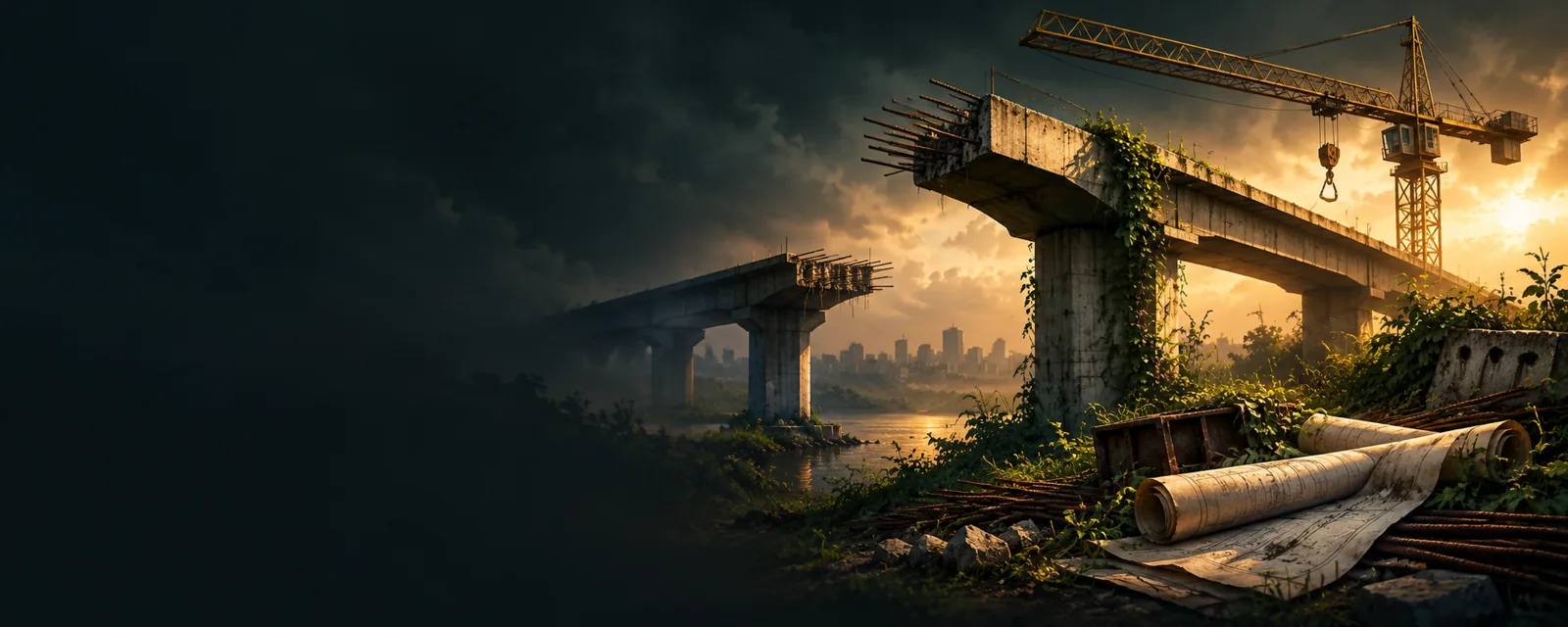
Fictional stalled bridge construction with a silent crane and weeds. Conceptual illustration.
Module · The receipts of failure

Project Graveyard

Nigeria's abandoned megaprojects — what was promised, what was spent, who got the contracts, and where it all went. Every figure, date, and contractor below is sourced; where we could not verify a fact, we say so instead of guessing.

Public BetaUnder Review

This section is being converted from structural scaffolding into verified source-backed records. Treat unsourced fields as under review until each row displays a source link and confidence label. See our evidence standards and source-work roadmap.

Project dossier · revival attempt

Close dossier

Ajaokuta Steel Complex

Conceived in 1979 as the anchor of Nigeria's industrialisation drive, Ajaokuta was designed to produce up to 5 million tonnes of steel a year from domestic iron ore. A leaked 2003 US diplomatic cable described it as a mechanism for awarding inflated contracts and kickbacks; construction stalled under Abacha in 1996 at roughly 90% completion and the plant has never produced commercial steel. Budget data shows ₦46.62bn allocated between 2017 and 2026 mostly for salaries and maintenance, and in July 2026 the government signed a 20-year gas supply deal with NNPC in yet another revival attempt.

Money / cost basis
US$5–8bn sunk — FG estimate ≥ US$5bn; World Bank ~US$7bn; Bloomberg reporting > US$8bn
Government level
Federal project; agency details in sources
Responsibility
See dated agency and contractor records; a verified attribution timeline is still being compiled
State / location
Kogi
Project timeline
1979 → 1996 (halted at ~90% completion)
Latest source review
Earlier compilation; current condition not independently verified

A stalled project is not automatically a total loss. Approvals, contract values, disbursements and proven diversion are distinct.

Source documents and reporting

·
revival attemptSteel / Industrial

Ajaokuta Steel Complex →

Kogi 1979 → 1996 (halted at ~90% completion)
Money involved
US$5–8bn sunk — FG estimate ≥ US$5bn; World Bank ~US$7bn; Bloomberg reporting > US$8bn

Conceived in 1979 as the anchor of Nigeria's industrialisation drive, Ajaokuta was designed to produce up to 5 million tonnes of steel a year from domestic iron ore. A leaked 2003 US diplomatic cable described it as a mechanism for awarding inflated contracts and kickbacks; construction stalled under Abacha in 1996 at roughly 90% completion and the plant has never produced commercial steel. Budget data shows ₦46.62bn allocated between 2017 and 2026 mostly for salaries and maintenance, and in July 2026 the government signed a 20-year gas supply deal with NNPC in yet another revival attempt.

Contractors
Soviet-era (Russian) technical partnersGerman technical partners
stalledPower

Mambilla Hydroelectric Power Project →

Taraba 1972 (first feasibility study); 1999 (federal inception) → Stalled by litigation from 2007 — never broke ground at scale
Money involved
US$5.792bn contract signed 2017 (85% Chinese financing, 15% FG); total spent undisclosed

Planned as Nigeria's largest hydropower plant at 3,050MW on the Dongo River in Taraba State, Mambilla has been studied since a 1972 feasibility report and formally pursued since 1999. A 2003 build-operate-transfer deal with Sunrise Power — which the presidency says the Federal Executive Council never authorised — triggered arbitration that froze the project for nearly two decades. In September 2026 an ICC tribunal in Paris rejected Sunrise's US$680m claim against Nigeria, clearing what President Tinubu called 'the single biggest legal hurdle' — though construction has still not begun.

Contractors
Consortium of Chinese contractors (2017 contract)
stalledRoads

East-West Road (Niger Delta dualisation) →

Edo, Delta, Bayelsa, Rivers, Akwa Ibom 2006 → Ongoing — sections incomplete nearly 20 years on
Money involved
Awarded at ₦211bn (2006), revised to ₦726bn; ₦300bn spent per Niger Delta minister (Dec 2017)

The 338km dual carriageway linking five Niger Delta states was awarded in 2006 at ₦211bn with a 2010 completion date — without, BusinessDay later reported, an actual engineering design or budgetary cover. Costs were revised upward to ₦726bn under President Jonathan, yet whole sections (notably Bayelsa's Adagbabiri–Mbiama stretch) remain unfinished. In December 2017 the Minister of Niger Delta Affairs said the road was 'designed to fail' and that ₦300bn had already been spent with little to show.

Contractors
Setraco Nigeria Ltd (later re-awarded the full stretch)
abandonedIdentity / Governance

National Identity Card Scheme (2001–2003) →

Nationwide 2001 (revived; originally initiated 1978) → 2003–2005 (collapsed amid bribery scandal)
Money involved
US$214m SAGEM contract (per 2011 House motion); ~₦25bn committed (per IT reporting)

After a 25-year false start dating to 1978, the Obasanjo administration revived the national ID card scheme in 2001 and registered an estimated 60 million adults in February 2003. The US$214m contract went to France's SAGEM amid allegations — later probed in French courts — that officials were bribed to secure the deal. Three former ministers (Sunday Afolabi, Mohammed Shata, Hussaini Akwanga) were charged over the scandal; the cards were haphazardly executed and the scheme was eventually scrapped and replaced by the NIMC.

Contractors
SAGEM (French electronics firm)
abandonedSecurity / Surveillance

Abuja CCTV / National Public Security Communication System →

FCT – Abuja 2010 (conceived 2008) → Never completed — multiple House probes (2011, 2016, 2025)
Money involved
US$470m contract (2010); US$399.5m China Exim loan + US$70.5m FG counterpart; ~US$36.4m/year still being repaid until ~2030

Conceived under Yar'Adua and awarded in 2010 under President Jonathan, the US$470m National Public Security Communication System was meant to blanket Abuja with CCTV and emergency-response infrastructure. ZTE maintains it delivered per the contract; lawmakers and investigators say the surveillance network never functioned. Nigeria keeps servicing the Chinese loan — an estimated US$36.4m a year until about 2030, per the Foundation for Investigative Journalism's analysis of Debt Management Office records — for cameras that do not watch the capital.

Contractors
ZTE Corporation (China)
revival attemptEducation / cultural infrastructure

National Library of Nigeria headquarters →

FCT 2006 → 2008 or 2012, conflicting government accounts
Money involved
₦118.3bn completion augmentation approved in August 2026, according to minister's FEC briefing; not total money spent or proven loss. Earlier remaining-cost estimates differ.

The headquarters construction has remained unfinished since a project launched in 2006. A March 2025 ministry statement proposed restarting work; an August 2026 ministerial briefing reported a ₦118.3bn completion augmentation. Neither announcement establishes completion or actual disbursement. Government accounts disagree on whether construction stopped in 2008 or 2012.

Contractors
Completion contractor not established in the retrieved evidence
revival attemptTourism / trade

Tinapa Business and Leisure Resort / Free Zone →

Cross River 2007 (established) → Not assigned; years of financial and operational difficulty
Money involved
Lifetime verified expenditure not established. The 2026 state citizens' budget identifies Tinapa renovation; budget appropriations are not actual spend.

Tinapa was established in 2007 as a trade and tourism investment. Cross River announced its formal return from AMCON in November 2025 and described plans to attract investors. Its 2026 budget continues to include renovation, so present this as a troubled asset under revival rather than a completed economic recovery.

Contractors
Original main contractor not established in the retrieved evidence
revival attemptPower / water

Ikere Gorge hydropower component →

Oyo 1970s/1980s development; precise original start requires archival confirmation → Long inactive power component; precise stoppage year unverified
Money involved
Verified historical expenditure and current concession investment not established; 6 MW refers to capacity, not currency.

The dam was developed for water supply and irrigation, with a long inactive hydropower component. The Federal Ministry of Power records a formal handover of the 6 MW power project to Quaint Energy on 31 January 2026. That concession is an important change in status; handover does not by itself prove electricity is being supplied to the grid.

Contractors
Quaint Energy Limited — January 2026 concession recipient, not asserted as original contractor
revival attemptTechnology / industrial development

Ibom Science Park →

Akwa Ibom Victor Attah administration, 1999–2007; precise groundbreaking unverified → Not established
Money involved
Verified cumulative public expenditure not established. ₦50m revised 2023 allocation and ₦10m 2024 re-evaluation allocation are reported appropriations. Promoters' US$250m conditional facility and US$411m proposed development are future plans, not money spent.

The state technology-park scheme remained largely undeveloped across successive administrations. Governor Umo Eno said in May 2026 that his government would not continue the original physical park and was open to private takeover. In August 2026 promoters announced talks to take it over and create a wider technology development; these remain proposals subject to approvals and due diligence.

Contractors
Original contractor unverified; Silicon Valley Science Park (Nigeria) Limited — proposed private revival promoter
abandonedUrban rail

Port Harcourt / Rivers Monorail →

Rivers 2009 reported; exact contract date requires primary record → 2015–2016 abandonment documented in contemporary reporting
Money involved
Audited final expenditure not established. Widely repeated US$400m / ₦68bn figures are political or media claims with different dates; do not label as proven loss or convert at today's rate.

A partially built monorail structure remains a prominent example of an unfinished state transport scheme. Contemporary reporting records Wike's decision not to complete it, while later community reporting describes the unused structure. Recent political disputes repeat expenditure accusations but do not substitute for audited contracts, payments or an engineering completion assessment.

Contractors
Intamin, reported system supplier; full historical contract chain requires primary procurement record

Growing source desk

Latest source records

2 source records

Records from approved publishers appear automatically with original links and dates. Announcements are attributed to their authors; delivery, spending and allegations need supporting evidence.

Collection: partial · last successful check: 2026-11-03T16:04:21.840551Z.

Some sources could not be checked
  • Library of Congress: TimeoutError: The read operation timed out

Project values are not summed across currencies, years or cost bases. Share a documented correction through the feedback bubble.

⬡ Citizen·0 pts·depth 0/10